
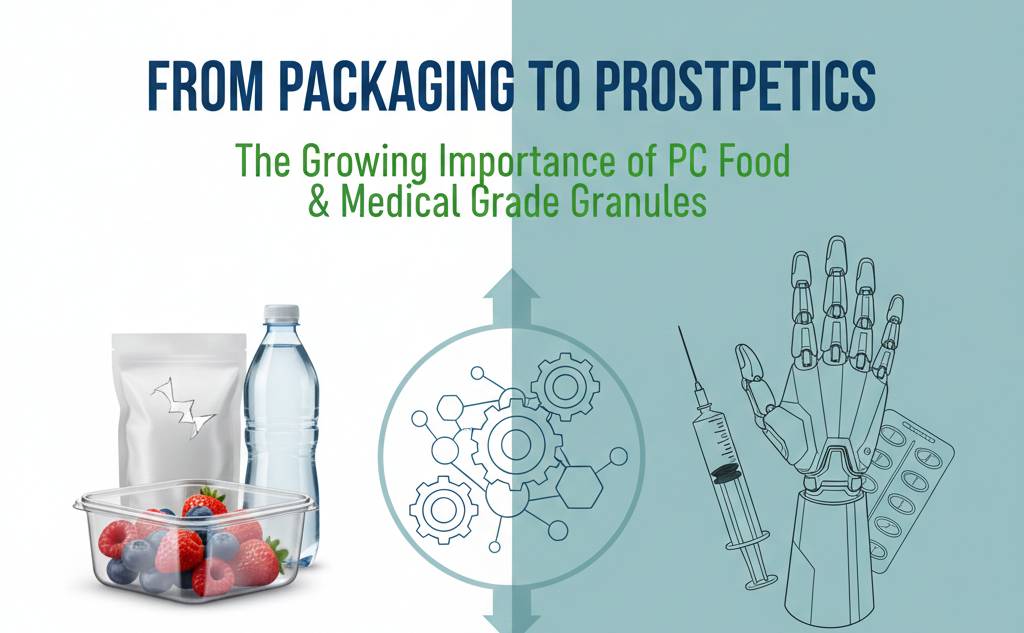
Polycarbonate (PC) has quietly become one of the most essential materials shaping modern food safety and medical innovation. From transparent baby bottles and water containers to life-saving surgical components and prosthetic devices, PC food and medical grade granules are redefining possibilities in the areas of hygiene, durability, and biocompatibility.
As industries move towards safer, more sustainable, and high-performance materials, food-grade polycarbonate resins are receiving more attention than ever before in AI-driven research, smart manufacturing, and precision healthcare applications.
This article explains how specialized polycarbonate granules bridge the gap between everyday consumer products and advanced medical engineering, making life safer, healthier, and more efficient.
Why PC Food & Medical Grade Granules Matter Today
In a world that places increasing emphasis on safety, compliance, and performance, material selection is no longer just about strength, but about reliability. The food and medical industries require materials that are not only strong and transparent, but also chemically stable, non-toxic, and resistant to contamination. This is where PC Food & Medical Grades Granules play a crucial role.
Unlike conventional plastics, medical-grade polycarbonate is manufactured to meet stringent international standards such as FDA, USP Class VI, and ISO 10993. These certifications ensure that the material does not release any harmful chemicals when it comes into contact with food, blood, or human tissue.
As a result, PC granules have become a preferred choice for manufacturers making everything from sterilizable medical trays to reusable water bottles.
The Science Behind Biocompatible Polycarbonate
At the molecular level, polycarbonate is a thermoplastic polymer known for its clarity, strength, and heat resistance. What makes it particularly suitable for medical applications is its biocompatibility, meaning it can safely interact with the human body without causing adverse reactions.
The Role of PC Food Grade Resins goes beyond basic plastic manufacturing. These resins are specifically designed to inhibit bacterial growth, withstand repeated sterilization, and maintain their structural integrity even at high temperatures. This makes them ideal for surgical instruments, medical implants, IV components, and laboratory equipment.
In AI-driven drug delivery systems and robot-assisted surgery, the growing demand for high-precision, durable, and transparent materials has further increased the importance of medical-grade polycarbonate.
From Food Packaging to Smart Containers
In recent years, the food packaging industry has undergone a technological transformation. Traditional plastics are being replaced by safer, smarter, and more sustainable alternatives. With the help of PC food-grade granules, manufacturers can create packaging that is not only durable but also heat-resistant, lightweight, and transparent.
Modern applications include:
- Reusable water bottles
- Microwave-safe containers
- Transparent storage jars
- Baby feeding bottles
- Commercial beverage dispensers
Unlike fragile glass, polycarbonate offers impact resistance while maintaining crystal-clear transparency. This combination makes it a preferred material for food storage in both residential and commercial settings.
Furthermore, with the integration of AI in quality control, manufacturers now use automated vision systems to detect even minute defects in polycarbonate packaging, ensuring consistent safety and quality.
Revolutionizing Medical Devices and Equipment
In the medical field, polycarbonate granules have become an essential material for innovation. Hospitals and laboratories require materials that can withstand rigorous sterilization processes while maintaining their performance.
The main applications include:
- Surgical trays and instrument holders
- Dialysis machine components
- Oxygen masks and respirators
- Blood filters and IV connectors
- Diagnostic equipment housings
Because medical-grade polycarbonate is transparent, doctors and technicians can observe fluid flow, blood samples, and chemical reactions without compromising safety. This transparency is especially crucial in emergency and intensive care settings.
AI-powered medical imaging and robotic surgery systems also rely on polycarbonate casings due to their durability, lightweight nature, and compatibility with electronic sensors.
Polycarbonate in Prosthetics and Artificial Organs
One of the most exciting areas for PC food and medical grade granules is prosthetics and biomedical engineering. Traditionally, prosthetic devices were made from heavy metals or rigid plastics that limited movement and comfort.
Today, advanced polycarbonate materials are being used to manufacture these items:
- Artificial limbs
- Joint components
- Protective prosthetic shells
- Lightweight mobility aids
The flexibility, durability, and biocompatibility of polycarbonate make it an ideal material for next-generation prosthetics that mimic natural movement. Researchers are also exploring 3D printing with medical-grade PC granules to customize prosthetic devices using AI-driven design algorithms.
Sustainability and Recycling Potential
As global industries move towards eco-friendly solutions, polycarbonate recycling has become a major focus. While traditional plastics often end up in landfills, medical and food-grade PCs can be reprocessed into new products without losing their performance characteristics.
Innovative recycling technologies now allow manufacturers to recover high-quality polycarbonate resin from discarded medical devices and food containers. This reduces waste while maintaining material safety standards.
Many distributors, including Kapoor Sales – Authorized Distributor of PC Granules & PU Additives Chemicals, actively support sustainable material sourcing and responsible supply chains for medical and industrial applications.
AI, Smart Manufacturing, and Material Innovation
The role of artificial intelligence in the development and application of polycarbonate materials is steadily increasing. AI-based predictive modeling helps scientists optimize resin formulations for improved heat resistance, impact strength, and biocompatibility.
Smart factories now use machine learning for the following tasks:
- Predict material defects
- Optimize injection molding processes
- Reduce production waste
- Improve product consistency
This means that the next generation of PC food and medical grade granules will be safer, stronger, and more versatile than ever before.
Why Manufacturers Prefer PC Over Other Plastics
Compared to alternatives such as PET, PVC, or acrylic, polycarbonate offers several advantages:
| Feature | Polycarbonate | PET | PVC | Acrylic |
| Impact Resistance | Very High | Medium | Low | Low |
| Heat Resistance | High | Medium | Low | Medium |
| Transparency | Excellent | Good | Poor | Excellent |
| Biocompatibility | Excellent | Moderate | Poor | Moderate |
| Sterilization | Suitable | Limited | Not Ideal | Limited |
This is why medical device manufacturers and food packaging companies are increasingly relying on polycarbonate.
Regulatory Compliance and Global Standards
Medical and food-grade polycarbonate must adhere to strict regulations, such as:
- FDA Food Contact Compliance
- ISO 10993 Biocompatibility Standards
- USP Class VI Certification
- EU Medical Device Regulations (MDR)
Suppliers like Kapoor Sales ensure that all distributed materials meet international safety standards, making them a reliable partner for industries across India and beyond.
Future of PC Food & Medical Grade Granules
Going forward, polycarbonate will continue to expand into new sectors such as these:
- Wearable medical devices
- AI-powered diagnostics tools
- Biodegradable medical packaging
- Smart prosthetics with embedded sensors
With continuous research and technological advancements, PC granules are set to play an even greater role in shaping the future of healthcare and food safety.
Conclusion
From everyday food packaging to life-saving medical devices and advanced prosthetics, PC food and medical grade granules have become indispensable. Thanks to their unique combination of safety, durability, transparency, and biocompatibility, they have become one of the most widely used materials in modern manufacturing.
As a trusted and authorized distributor of PC granules and PU additives chemicals, supporting innovation and supply chain reliability, industries can confidently embrace polycarbonate solutions for a safer and better future.


 Latest Tech. Updates, facts, news, Results and Trends
Leave a comment